
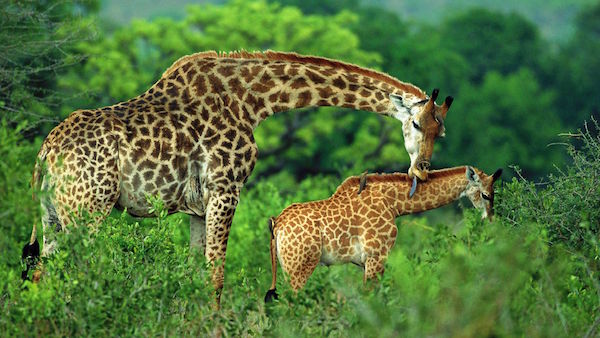
GIRAFFE
The giraffe is a large African hoofed mammal belonging to the genus Giraffa. It is the tallest living terrestrial animal and the largest ruminant on Earth. Traditionally, giraffes have been thought of as one species, Giraffa camelopardalis, with nine subspecies. Most recently, researchers proposed dividing them into four extant species due to new research into their mitochondrial and nuclear DNA, and individual species can be distinguished by their fur coat patterns. Six valid extinct species of Giraffa from Africa and Pakistan are known from the fossil record.
The giraffe's distinguishing characteristics are its extremely long neck and legs, horn-like ossicones, and spotted coat patterns. It is classified under the family Giraffidae, along with its closest extant relative, the okapi. Its scattered range extends from Chad in the north to South Africa in the south and from Niger in the west to Somalia in the east. Giraffes usually inhabit savannahs and woodlands. Their food source is leaves, fruits, and flowers of woody plants, primarily acacia species, which they browse at heights most other ground-based herbivores cannot reach.
The giraffe has intrigued various ancient and modern cultures for its peculiar appearance and has often been featured in paintings, books, and cartoons. It is classified by the International Union for Conservation of Nature (IUCN) as vulnerable to extinction. It has been extirpated from many parts of its former range. Giraffes are still found in many national parks and game reserves, but estimates as of 2016 indicate there are approximately 97,500 members of Giraffa in the wild. More than 1,600 were kept in zoos in 2010
Fully grown giraffes stand 4.3–5.7 m (14–19 ft) tall, with males taller than females. The average weight is 1,192 kg (2,628 lb) for an adult male and 828 kg (1,825 lb) for an adult female. Despite its long neck and legs, its body is relatively short. The skin is mostly gray or tan, and can reach a thickness of 20 mm (0.79 in).The 80–100 cm (31–39 in) long tail ends in a long, dark tuft of hair and is used as a defense against insects. The coat has dark blotches or patches, which can be orange, chestnut, brown, or nearly black, surrounded by light hair, usually white or cream coloured. Male giraffes become darker as they grow old. The coat pattern has been claimed to serve as camouflage in the light and shade patterns of savannah woodlands. When standing among trees and bushes, they are hard to see at even a few metres distance. However, adult giraffes move about to gain the best view of an approaching predator, relying on their size and ability to defend themselves rather than on camouflage, which may be more important for calves. Each giraffe has a unique coat pattern. Calves inherit some coat pattern traits from their mothers, and variation in some spot traits is correlated with calf survival. The skin under the blotches may regulate the animal's body temperature, being sites for complex blood vessel systems and large sweat glands. Spotless or solid-color giraffes are very rare, but have been observed
WHERE WILL YOU FIND THEM
You will find the giraffes at pen ,