
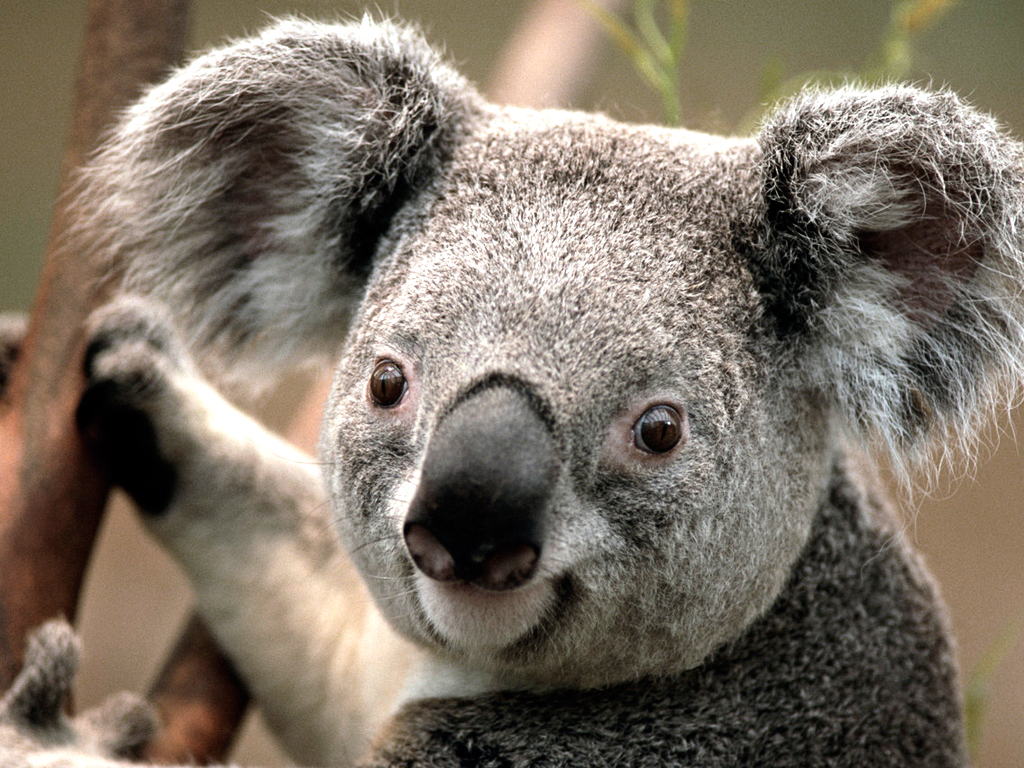
KOALA
The koala (Phascolarctos cinereus), sometimes inaccurately called the koala bear, is an arboreal herbivorous marsupial native to Australia. It is the only extant representative of the family Phascolarctidae. Its closest living relatives are the wombats. The koala is found in coastal areas of the island's eastern and southern regions, inhabiting Queensland, New South Wales, Victoria, and South Australia. It is easily recognisable by its stout, tailless body and large head with round, fluffy ears and large, dark nose. The koala has a body length of 60–85 cm (24–33 in) and weighs 4–15 kg (8.8–33.1 lb). Its fur colour ranges from silver grey to chocolate brown. Koalas from the northern populations are typically smaller and lighter in colour than their counterparts further south. These populations are possibly separate subspecies, but not all researchers accept this.
Koalas typically inhabit open Eucalyptus woodland, as the leaves of these trees make up most of their diet. This eucalypt diet has low nutritional and caloric content and contains toxic compounds that deter most other mammals from feeding on them. Koalas are largely sedentary and sleep up to twenty hours a day. They are asocial; only mothers bond to dependent offspring. Adult males communicate with bellows that intimidate rivals and attract mates. Males mark their presence with secretions from scent glands located on their chests. Like other marsupials, koalas give birth to young known as joeys at a very early stage of development. They crawl into their mothers' pouches, where they live for their first six to seven months. They are fully weaned around a year old. Koalas have few natural predators and parasites, but are threatened by pathogens such as Chlamydiaceae bacteria and koala retrovirus. Because of their distinctive appearance, koalas, along with kangaroos, are recognised worldwide as symbols of Australia. They were hunted by Indigenous Australians and depicted in myths and cave art for millennia. The first recorded encounter between a European and a koala was in 1798, and an image of the animal was published in 1810 by naturalist George Perry. Botanist Robert Brown wrote the first detailed scientific description in 1814 although his work remained unpublished for 180 years. Artist John Gould illustrated and described the koala, thereby introducing the species to the British public. Further details about the animal's biology were revealed in the 19th century by English scientists. Koalas are listed as a vulnerable species by the International Union for Conservation of Nature. Among the many threats to their existence are habitat destruction caused by agriculture, urbanisation, droughts, and associated bushfires, some related to climate change. In February 2022, the koala was officially listed as endangered in the Australian Capital Territory, New South Wales, and Queensland.
Three subspecies have been described: the Queensland koala (Phascolarctos cinereus adustus, Thomas 1923), the New South Wales koala (Phascolarctos cinereus cinereus, Goldfuss 1817), and the Victorian koala (Phascolarctos cinereus victor, Troughton 1935). These forms are distinguished by pelage colour and thickness, body size, and skull shape. The Queensland koala is the smallest, with silver or grey short hairs and a shorter skull. The Victorian koala is the largest, with shaggier, brown fur and a wider skull.[22]: 7 [23] The geographic limits of these variations are based on state borders, and their status as subspecies is disputed. A 1999 genetic study suggests koalas exist as a cline within a single evolutionarily significant unit with limited gene flow between local populations.[23] In 2016, a comprehensive phylogenetic study did not support the recognition of any subspecies.[24] Other studies have found that koala populations are highly inbred with low genetic variation.[25][26] Such low genetic diversity may have been caused by population declines during the late Pleistocene.[27] Rivers and roads limit gene flow and contribute to the isolation of southeast Queensland populations.[28] In April 2013, scientists from the Australian Museum and Queensland University of Technology announced they had fully sequenced the koala genome.[29]
The koala's range covers roughly 1,000,000 km2 (390,000 sq mi), and 30 ecoregions.[41] It ranges throughout mainland eastern and southeastern Australia, including the states of Queensland, New South Wales, Victoria, and South Australia. The koala was introduced to several nearby islands.[1] The population on Magnetic Island represents the northern limit of its range.[41] Fossil evidence shows that the koala's range stretched as far west as southwestern Western Australia during the late Pleistocene. They were likely driven to extinction in these areas by environmental changes and hunting by Indigenous Australians.[22]: 12–13 Koalas were introduced to Western Australia at Yanchep in 1938 but that population was reduced to 4 individuals by 2022.[42] Koalas can be found in both tropical and temperate habitats ranging from dense woodlands to more spaced-out forests.[31] In semi-arid climates, they prefer riparian habitats, where nearby streams and creeks provide refuge during times of drought and extreme heat.[43]
WHERE WILL YOU FIND THEM
You will find the Koalas at pen , right next to the